Arlene Peterson
The Outsider (Stephen King Edition)Arlene Peterson is the wife of Fred Peterson and mother of Frank and Ollie Peterson. In the wake of Frank’s murder, she holds together the practical work of mourning: arranging his memorial and funeral, receiving visitors, and keeping the family’s affairs in order. Her death at home, after an evening of condolences for her son, turns that already exhausting bereavement into a second family catastrophe and leaves Fred and Ollie to make arrangements she had previously handled.
Identity and Family Role
Arlene is remembered by Fred as a slender, beautiful bride when they married, and as still slender after Ollie’s birth. She began gaining weight after Frank was born; by the time of the story she is close to obesity. Fred remains devoted to her, even as a doctor’s advice about her type two diabetes and the need to lose weight makes her health a concern within their marriage. The detail establishes both the long domestic history between them and the strain of a condition that the family’s sudden losses will soon make urgent.
Her role in the household is practical as well as intimate. Fred describes their arrangement as one in which he earned the money and Arlene paid the bills. She had also taken responsibility for organizing family rites and social arrangements. Fred, who says he is not good at making such arrangements, depends on her competence; when she is gone, tasks that once belonged to their ordinary division of labor become immediate problems for him and Ollie.
Frank’s Memorial and the Gathering
Arlene arranged the funeral home, obituary, flowers, memorial service, funeral, graveside service, and the Saturday evening gathering for Frank. The scale of the family’s mourning is apparent in the house afterward: around fifty or sixty people had passed through, including neighbors, well-wishers from elsewhere in town, and members of the church community. The gathering had been intended as remembrance, but news of Terry Maitland’s arrest for Frank’s murder drew visitors back and gave the evening a second, grim focus.
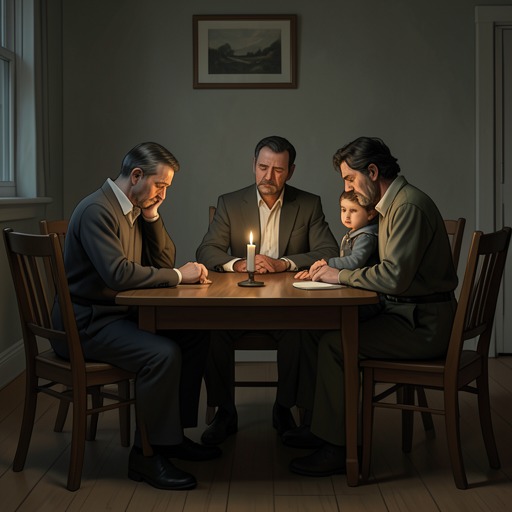
By the time the last guests left, Arlene sat on the sofa in her best silk dress, her hands around her upper arms, and said nothing. Fred and Ollie cleaned up in silence. They had received condolences for hours, including sincere expressions from strangers, but could not offer comfort to one another. The scene makes Arlene’s quiet presence part of the family’s grief: she has organized the public rituals of mourning, yet the gathering has not made private consolation easier.
Medical Emergency and Death
While Fred and Ollie were still tidying the house, laughter came from the kitchen. It first sounded natural, then rose to a hysterical pitch. Arlene stood near the sink, holding her belly, her face flushed and tears running down her cheeks. When Ollie asked what was wrong, she answered that she thought it was her heart, then noticed the food scattered around her and remarked on the mess. Fred tried to catch her as she collapsed. Ollie called for help while Fred checked for a pulse and began pressing on her chest.
Fred’s efforts seemed briefly to succeed: Arlene opened her eyes, and he thought she was back. But the ambulance took her to Mercy Hospital, where Fred and Ollie waited through the night. At 9:10 Sunday morning, a doctor told them that she had died. He said the damage had been too great, despite the hospital’s efforts. Fred cried out at the news; Ollie understood that the family that had existed the week before had become only the two of them. Arlene’s death follows Frank’s rather than resolving the family’s grief, and the timing makes the home gathering’s cleanup an abrupt passage from public mourning to medical crisis.
Aftermath and Narrative Significance
Arlene had also managed the arrangements for Frank’s funeral because Fred was not equipped to take them on. After she dies, he must arrange her funeral in turn, even as he is exhausted and unsure how to pay for it. He and Ollie find burial insurance papers in a folder in her desk, between the mortgage agreement and appliance warranties. The papers show that she had prepared for practical contingencies, but they cannot spare her family the work of acting in her place.
Ollie refuses to make the arrangements himself, saying that his father should do so. He quietly completes the obituary form, then clears the kitchen, where the food and dishes left from the gathering remain. Familiar household work and sayings associated with Arlene survive as small reminders amid the loss. The family’s roles have shifted: the mother who organized the rites is now the person being mourned, and her teenage son takes on tasks while his father faces the decisions she once handled.
Arlene’s presence in the narrative is concentrated in this sequence of practical care, bereavement, and sudden death. Her arrangements give shape to the community’s response to Frank’s murder, but the crowded gathering also exposes the limits of public consolation. After her death, the funeral paperwork, the uncompleted cleanup, and Ollie’s quiet grief carry the consequences forward. Her loss is not simply another piece of background to Frank’s case; it changes the Peterson household from a grieving family into a father and son left to manage the aftermath together.